


How can the processing technology of semi-light wood grain board substrate ensure its surface flatness?
Release Time : 2025-12-17
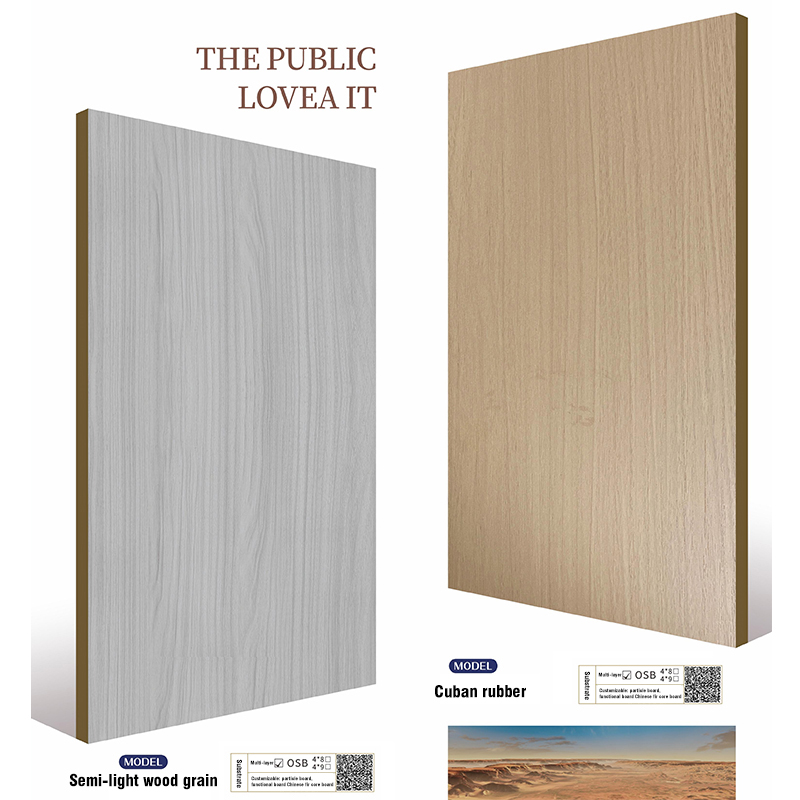
The processing of semi-light wood grain board substrate requires multi-stage collaborative control to ensure surface flatness. The core logic lies in meticulous management throughout the entire process, from raw material pretreatment, substrate molding, surface processing to quality inspection, to avoid deformation caused by material defects, process errors, or environmental interference.
Raw material selection and pretreatment are fundamental guarantees. Semi-light wood grain board substrates often use calcium silicate board, MDF, or particleboard as the core carrier, requiring priority to be given to raw materials with uniform density and stable moisture content. For example, calcium silicate board uses siliceous-calcareous materials as the main binder, so the dispersion of inorganic mineral fibers or cellulose fibers in the raw material must be controlled to avoid local density differences caused by fiber agglomeration; MDF, on the other hand, must ensure that the wood fibers have a dense structure after high-temperature and high-pressure molding, without voids or loose areas. The pretreatment stage requires drying the raw materials, controlling the moisture content within the range of 8%-12%, to prevent substrate shrinkage or expansion caused by moisture evaporation.
The substrate molding process directly affects structural stability. Taking calcium silicate board as an example, its production involves processes such as pulping, molding, and autoclaving. Temperature and pressure control during autoclaving are particularly crucial. Excessive temperature fluctuations or insufficient pressure can lead to incomplete gel crystallization, resulting in uneven stress distribution within the substrate and subsequent warping. For MDF and particleboard, temperature and pressure gradients must be controlled during the hot-pressing process to ensure complete adhesive curing while preventing excessive pressure that could compress the fibers and cause localized depressions.
Surface finishing is the core of flatness control. After molding, the substrate requires sanding, using multiple sanding passes to remove burrs, protrusions, or adhesive residue. The sander must employ a precision tension control system to ensure uniform pressure between the sanding belt and the board surface, preventing over-sanding due to excessive pressure or leaving defects due to insufficient pressure. For substrates requiring wood grain paper or wood veneer, cleaning is necessary after sanding to remove surface dust and oil, preventing impurities from affecting the adhesion strength between the adhesive layer and the substrate, leading to later blistering or wrinkling. The precision of the bonding process determines the final surface finish. High-temperature, high-pressure lamination technology is required when bonding wood grain paper or wood veneer to ensure complete adhesion between the bonding layer and the substrate. For example, wood grain paper bonding requires controlling the hot-pressing temperature between 120℃ and 150℃ and the pressure between 3MPa and 5MPa to fully activate the adhesive and allow it to penetrate into the micropores of the substrate, forming a mechanically interlocking structure. Insufficient temperature or pressure will result in incomplete adhesive curing, easily leading to peeling of the bonding layer; excessively high parameters may cause substrate deformation due to thermal stress. Furthermore, positioning molds must be used during the bonding process to ensure the wood grain pattern is aligned, preventing misalignment from affecting visual flatness.
Environmental factors must be controlled throughout the process. The processing workshop must maintain constant temperature and humidity conditions, with temperature fluctuations controlled within ±5℃ and humidity controlled between 40% and 60% to prevent dimensional changes in the substrate due to moisture absorption or loss. For example, calcium silicate boards are prone to moisture absorption and expansion in high-humidity environments, while MDF (medium-density fiberboard) may become more brittle due to low humidity; both require environmental control to reduce the risk of deformation.
Quality inspection is the ultimate guarantee. A laser profilometer or coordinate measuring machine must be used to perform a full-size scan of the substrate surface to check if the flatness error is controlled within ±0.2mm. For products with wood grain paper or wood veneer, visual inspection and tactile testing are also required to ensure the absence of defects such as bubbles, wrinkles, or edge lifting.
Surface flatness control of semi-light wood grain board substrate must be implemented throughout the entire process, from raw materials, molding, processing, bonding, and inspection. Through process parameter optimization, improved equipment precision, and environmental control, comprehensive flatness from the microstructure to the macroscopic surface can be achieved, ultimately meeting the dual requirements of aesthetics and durability in high-end decorative scenarios.