


How to balance the hardness and toughness of Huike pear wood board base material in intricate carving and large-area veneer applications?
Release Time : 2026-01-24
Pear wood, as a traditional high-quality hardwood, is highly favored in home and public space decoration. Its fine texture, uniform grain, and warm color are particularly valuable. It also possesses a suitable balance of moderate hardness and good toughness—a characteristic that makes it suitable for both intricate carving techniques and modern decorative needs such as large-area veneer panels, wall panels, or furniture surfaces. However, achieving a perfect balance between "detailed carving" and "stable installation" requires a deep understanding of the inherent properties of Huike pear wood board base material and scientific processing control.
1. Material Advantages: The Natural Synergy of Hardness and Toughness
The air-dry density of pear wood is typically between that of softwood and heavy hardwood. This density gives it sufficient hardness to resist daily scratches and indentations, ensuring the veneer remains smooth and glossy over time. At the same time, its dense and elastic fiber structure gives it superior fracture toughness compared to many hardwoods of the same density, making it less prone to chipping or cracking under stress. This "balance of strength and flexibility" allows carving tools to offer moderate resistance and smooth cutting, enabling precise rendering of details such as leaf veins, scrolls, and relief carvings without edge breakage due to the material's brittleness.
2. Fine Carving: Relying on a Stable Microstructure
Pear wood's fine growth rings, smooth transition between earlywood and latewood, and small, evenly distributed vessel pores provide an ideal microscopic foundation for carving. In high-precision CNC carving or hand-carving, the tool path can advance steadily, less prone to skipping or burrs due to localized hardening or looseness. Especially when creating components requiring openwork or deep relief carving, such as latticework, screens, and lintels, pear wood's toughness ensures the integrity of its thin-walled structure, allowing even the finest joints to withstand processing stress without breaking. Furthermore, its low shrinkage rate and minimal anisotropy further reduce the risk of deformation due to stress release after carving.
3. Large-Area Finishes: Stability is Key
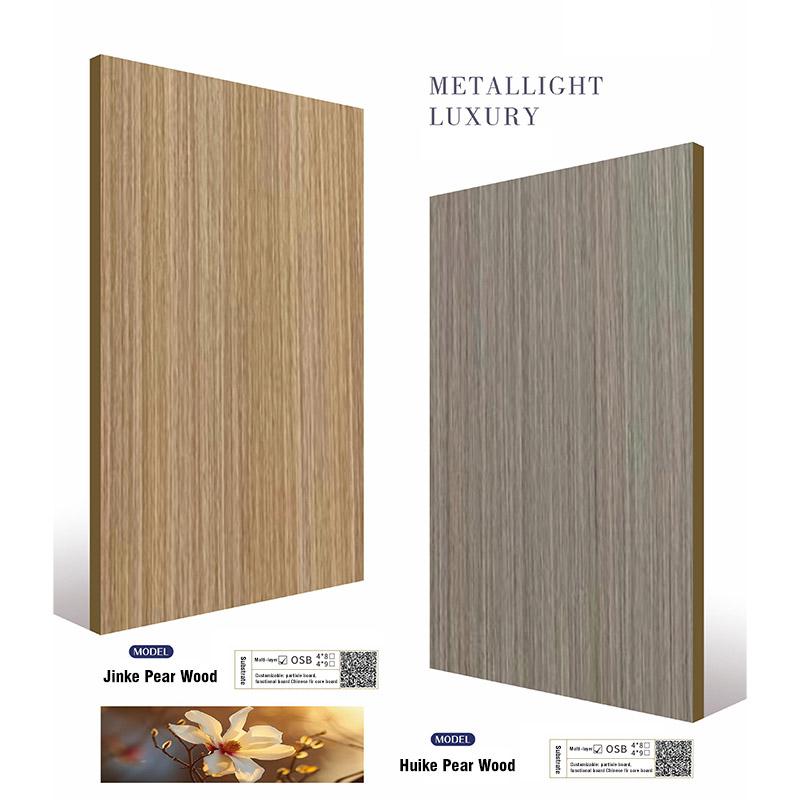
In large-area applications such as walls, cabinets, or countertops, Huike pear wood board base material must overcome the inherent expansion and contraction characteristics of wood due to moisture. By strictly controlling moisture content and using radially cut boards or cross-laminated structures, warping, twisting, or joint cracking can be effectively suppressed. Its moderate hardness also prevents indentations or collapses during hot pressing, edge banding, or sanding, ensuring overall surface flatness and visual continuity. Simultaneously, the smooth surface and fine pores of pear wood provide excellent adhesion for varnishes, wood wax oils, or stains, resulting in a uniform and translucent finish that highlights the beauty of natural wood grain.
4. Process Synergy: Systematic Control from Material Selection to Processing
Achieving a perfect match between carving and finishing requires optimization of the entire process. Logs must undergo thorough natural drying and kiln drying to eliminate internal stress; radially cut boards, free of knots and cracks and with straight grain, are preferred for carving, while tangentially cut boards can be used for finishing areas where grain direction is less critical. During processing, sharp tools, appropriate feed rates, and cutting depths are used to avoid localized charring or fiber tearing caused by frictional heat. For composite structures, the gluing process must be matched to the wood's expansion coefficient to prevent later delamination.
5. Integrative Innovation in Application Scenarios
Due to this balance, pear wood is widely used in places requiring both artistic expression and functional durability—such as carved background walls in hotel lobbies, intricate edging for museum display cases, and custom wall panels in high-end residences. Designers can seamlessly combine three-dimensional carving and planar extension within a single space without changing materials, achieving stylistic unity and cost optimization.
Huike pear wood board base material, with its unique hardness-toughness ratio, serves as a bridge connecting traditional craftsmanship and modern decoration. Through scientific material selection, precise drying, and meticulous processing, it can both bear the beauty of meticulously crafted details and support stable performance in large-scale spaces, truly realizing the decorative ideal of "craftsmanship in the details, grandeur in the expansive."
1. Material Advantages: The Natural Synergy of Hardness and Toughness
The air-dry density of pear wood is typically between that of softwood and heavy hardwood. This density gives it sufficient hardness to resist daily scratches and indentations, ensuring the veneer remains smooth and glossy over time. At the same time, its dense and elastic fiber structure gives it superior fracture toughness compared to many hardwoods of the same density, making it less prone to chipping or cracking under stress. This "balance of strength and flexibility" allows carving tools to offer moderate resistance and smooth cutting, enabling precise rendering of details such as leaf veins, scrolls, and relief carvings without edge breakage due to the material's brittleness.
2. Fine Carving: Relying on a Stable Microstructure
Pear wood's fine growth rings, smooth transition between earlywood and latewood, and small, evenly distributed vessel pores provide an ideal microscopic foundation for carving. In high-precision CNC carving or hand-carving, the tool path can advance steadily, less prone to skipping or burrs due to localized hardening or looseness. Especially when creating components requiring openwork or deep relief carving, such as latticework, screens, and lintels, pear wood's toughness ensures the integrity of its thin-walled structure, allowing even the finest joints to withstand processing stress without breaking. Furthermore, its low shrinkage rate and minimal anisotropy further reduce the risk of deformation due to stress release after carving.
3. Large-Area Finishes: Stability is Key
In large-area applications such as walls, cabinets, or countertops, Huike pear wood board base material must overcome the inherent expansion and contraction characteristics of wood due to moisture. By strictly controlling moisture content and using radially cut boards or cross-laminated structures, warping, twisting, or joint cracking can be effectively suppressed. Its moderate hardness also prevents indentations or collapses during hot pressing, edge banding, or sanding, ensuring overall surface flatness and visual continuity. Simultaneously, the smooth surface and fine pores of pear wood provide excellent adhesion for varnishes, wood wax oils, or stains, resulting in a uniform and translucent finish that highlights the beauty of natural wood grain.
4. Process Synergy: Systematic Control from Material Selection to Processing
Achieving a perfect match between carving and finishing requires optimization of the entire process. Logs must undergo thorough natural drying and kiln drying to eliminate internal stress; radially cut boards, free of knots and cracks and with straight grain, are preferred for carving, while tangentially cut boards can be used for finishing areas where grain direction is less critical. During processing, sharp tools, appropriate feed rates, and cutting depths are used to avoid localized charring or fiber tearing caused by frictional heat. For composite structures, the gluing process must be matched to the wood's expansion coefficient to prevent later delamination.
5. Integrative Innovation in Application Scenarios
Due to this balance, pear wood is widely used in places requiring both artistic expression and functional durability—such as carved background walls in hotel lobbies, intricate edging for museum display cases, and custom wall panels in high-end residences. Designers can seamlessly combine three-dimensional carving and planar extension within a single space without changing materials, achieving stylistic unity and cost optimization.
Huike pear wood board base material, with its unique hardness-toughness ratio, serves as a bridge connecting traditional craftsmanship and modern decoration. Through scientific material selection, precise drying, and meticulous processing, it can both bear the beauty of meticulously crafted details and support stable performance in large-scale spaces, truly realizing the decorative ideal of "craftsmanship in the details, grandeur in the expansive."