


How to achieve complex shapes without sacrificing structural integrity using Huike pear wood board base material's moderate hardness and toughness?
Release Time : 2026-02-18
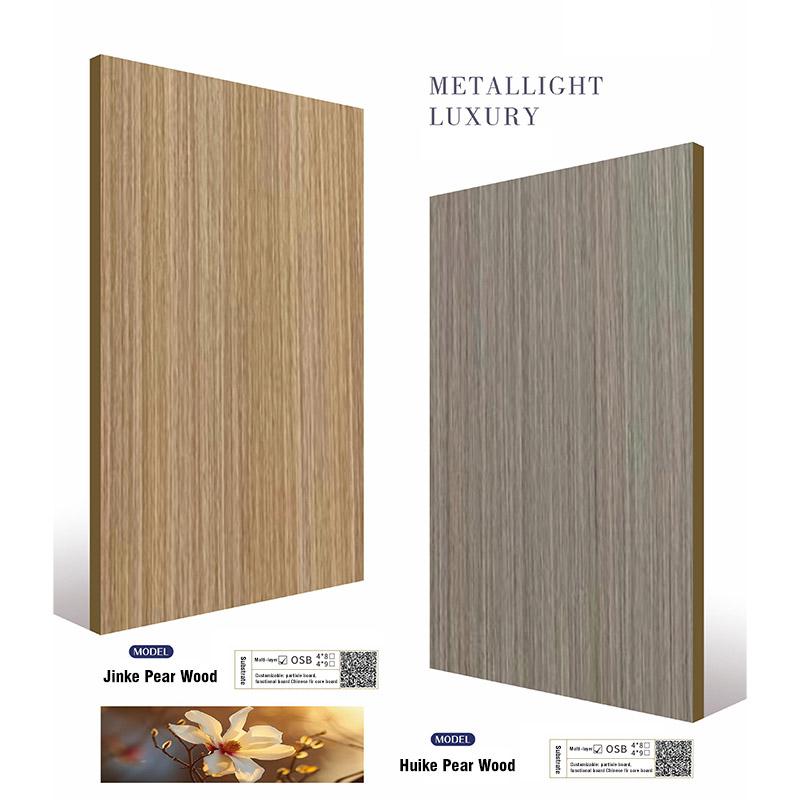
In the field of high-end home and public space decoration, materials must not only embody aesthetic expression but also possess reliable engineering performance. Huike pear wood board base material, with its natural characteristics of moderate hardness and toughness, has become a preferred material for designers—it is neither as difficult to carve as hard maple nor as too soft and fragile as pine. This "balanced" physical endowment allows it to meet the demands of fine processing while maintaining structural integrity for long-term use when achieving complex shapes such as curved surfaces, openwork, and reliefs.
1. Material Advantages: A Natural Foundation for Fine Processing
Pear wood has a fine and even grain, dense growth rings, and an air-dry density typically between 0.65 and 0.75 g/cm³, falling between softwood and hardwood. This characteristic gives it excellent cutting performance: low tool resistance, less prone to chipping or tearing; at the same time, its fiber structure has good ductility, making it less prone to cracking when bent or partially hollowed out. More importantly, pear wood has a low shrinkage coefficient, and after proper drying, it exhibits excellent dimensional stability. Even in public places with significant temperature and humidity fluctuations, it effectively prevents joint misalignment or structural failure caused by deformation. This dual advantage of "easy processing + low deformation" provides natural feasibility for complex shapes.
2. Process Synergy: Systematic Control from Design to Form
To transform the potential of pear wood into actual shapes, a synergistic process across the entire chain of "design—processing—shaping" is necessary. First, in the design phase, areas of stress concentration should be avoided. For example, sharp angle transitions should use rounded corners, and hollow patterns should retain sufficient support rib width. Second, in the processing stage, CNC engraving combined with high-speed precision milling can accurately achieve three-dimensional curved surfaces and fine textures. Simultaneously, a layered cutting strategy reduces the depth of a single cut, avoiding localized overheating or fiber pull-out. For parts requiring bending, steam softening or high-frequency heating technology can be used to enhance plasticity without damaging the wood structure. Immediately afterward, a shaping fixture is used for cooling to lock in the new shape. The entire process emphasizes "gentle force application and gradual shaping" to preserve the wood's inherent strength to the maximum extent.
3. Structural Reinforcement: Invisible Support Ensures Long-Term Reliability
Even though pear wood itself has good toughness, structural reinforcement measures are still necessary for extreme designs. Common practices include: embedding lightweight aluminum alloy framing or carbon fiber mesh on the back, increasing bending stiffness with almost no increase in visual thickness; or using mortise and tenon joints with environmentally friendly adhesive at splicing nodes instead of simple nailing, improving overall shear resistance. In addition, applying a sealing primer before surface coating not only improves the adhesion of the finish but also forms a microporous barrier layer, slowing down moisture exchange and further inhibiting micro-deformation during long-term use. These "invisible reinforcement" methods provide durable structural protection for complex designs without sacrificing aesthetic purity.
4. Application Scenarios Prove It: From Art Screens to Public Installations
In practical applications, the design potential of pear wood panels has been widely validated. The curved wayfinding walls in high-end hotel lobbies, the relief cultural exhibition panels in museums, and the translucent grille screens in residential entrances—these functional and artistic components all rely on the balance between plasticity and stability of pear wood. Especially in high-traffic public spaces, its wear-resistant, impact-resistant, and low-maintenance properties ensure that complex designs retain their original form and texture even after years of use, truly embodying the principle that "form follows function, and beauty originates from reliability."
In conclusion, the ability of Huike pear wood board base material to navigate between complex shapes and structural integrity stems not only from its superior natural properties but also from the deep exploration of its potential by modern technology. Through scientific design, meticulous processing, and intelligent reinforcement, pear wood is not merely a decorative material but also a bridge connecting artistic creativity and engineering rationality, silently supporting the poetry and order of space.
1. Material Advantages: A Natural Foundation for Fine Processing
Pear wood has a fine and even grain, dense growth rings, and an air-dry density typically between 0.65 and 0.75 g/cm³, falling between softwood and hardwood. This characteristic gives it excellent cutting performance: low tool resistance, less prone to chipping or tearing; at the same time, its fiber structure has good ductility, making it less prone to cracking when bent or partially hollowed out. More importantly, pear wood has a low shrinkage coefficient, and after proper drying, it exhibits excellent dimensional stability. Even in public places with significant temperature and humidity fluctuations, it effectively prevents joint misalignment or structural failure caused by deformation. This dual advantage of "easy processing + low deformation" provides natural feasibility for complex shapes.
2. Process Synergy: Systematic Control from Design to Form
To transform the potential of pear wood into actual shapes, a synergistic process across the entire chain of "design—processing—shaping" is necessary. First, in the design phase, areas of stress concentration should be avoided. For example, sharp angle transitions should use rounded corners, and hollow patterns should retain sufficient support rib width. Second, in the processing stage, CNC engraving combined with high-speed precision milling can accurately achieve three-dimensional curved surfaces and fine textures. Simultaneously, a layered cutting strategy reduces the depth of a single cut, avoiding localized overheating or fiber pull-out. For parts requiring bending, steam softening or high-frequency heating technology can be used to enhance plasticity without damaging the wood structure. Immediately afterward, a shaping fixture is used for cooling to lock in the new shape. The entire process emphasizes "gentle force application and gradual shaping" to preserve the wood's inherent strength to the maximum extent.
3. Structural Reinforcement: Invisible Support Ensures Long-Term Reliability
Even though pear wood itself has good toughness, structural reinforcement measures are still necessary for extreme designs. Common practices include: embedding lightweight aluminum alloy framing or carbon fiber mesh on the back, increasing bending stiffness with almost no increase in visual thickness; or using mortise and tenon joints with environmentally friendly adhesive at splicing nodes instead of simple nailing, improving overall shear resistance. In addition, applying a sealing primer before surface coating not only improves the adhesion of the finish but also forms a microporous barrier layer, slowing down moisture exchange and further inhibiting micro-deformation during long-term use. These "invisible reinforcement" methods provide durable structural protection for complex designs without sacrificing aesthetic purity.
4. Application Scenarios Prove It: From Art Screens to Public Installations
In practical applications, the design potential of pear wood panels has been widely validated. The curved wayfinding walls in high-end hotel lobbies, the relief cultural exhibition panels in museums, and the translucent grille screens in residential entrances—these functional and artistic components all rely on the balance between plasticity and stability of pear wood. Especially in high-traffic public spaces, its wear-resistant, impact-resistant, and low-maintenance properties ensure that complex designs retain their original form and texture even after years of use, truly embodying the principle that "form follows function, and beauty originates from reliability."
In conclusion, the ability of Huike pear wood board base material to navigate between complex shapes and structural integrity stems not only from its superior natural properties but also from the deep exploration of its potential by modern technology. Through scientific design, meticulous processing, and intelligent reinforcement, pear wood is not merely a decorative material but also a bridge connecting artistic creativity and engineering rationality, silently supporting the poetry and order of space.